Sreeleela’s festive fashion image centres on a rani-pink, orange and purple lehenga. A Vogue India report published on 12 September identifies it as Amaare by Sahib Bhatia and makes the handwork part of the story. Its appeal lies in the control: a richly worked skirt, a clearer blouse line and jewellery that echoes the palette without competing.
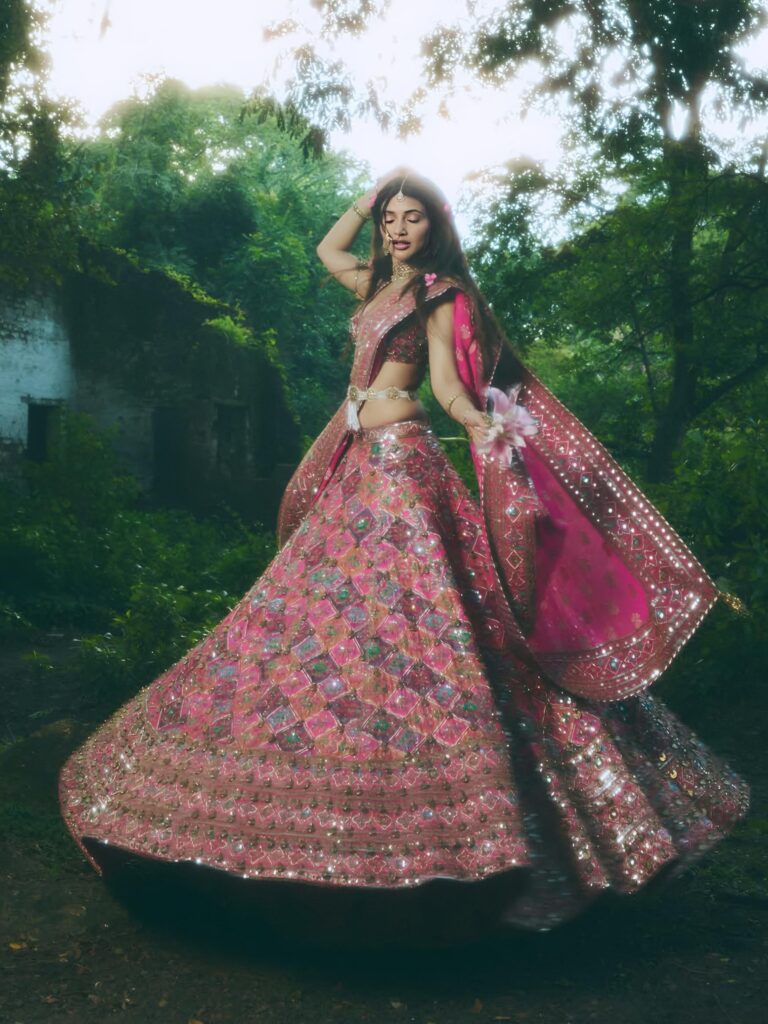
The silhouette does much of that balancing. Vogue’s detailed description calls it a bohemian kalidar lehenga built from diamond-shaped panels, each enclosing a floral motif. The sleeveless Queen Anne-inspired V-neck blouse is made in silk georgette and finished with an open back and tie-ups. A matching fuchsia organza-silk dupatta, described as handwoven in Meenakari Banarasi, brings colour and weave to the upper half without adding another competing print.
The craft list can sound dense, so read it as a layered metallic-embroidery vocabulary. Zardozi is the raised metalwork; dabka and kora add coiled or tubular wire texture; nakshi and sadi are finer ornamental components used to draw and fill motifs. Hand-cut gota means ribbon cut and placed piece by piece, while sequins add flat flashes. Amaare’s figures, reported by Vogue, put the labour at more than 150 hours for embroidery and about 15–20 days for the dupatta’s hand-weaving.
The accessories continue the craft conversation without turning the outfit into a pile-on. Sreeleela wears a jadau choker, bajubandh, haathphool, maang tikka and earrings from Shri Paramani Jewels; Vogue reports that the pieces use natural rubies and uncut diamonds and were designed with measured proportions. Soft waves, fresh flowers and pink-toned makeup keep the face and hair quiet. For a wedding guest, the useful formula is one statement jewellery family, not several unrelated finishes.
Read more on how Sreeleela is ushering in the festive season
Borrow the logic rather than the full volume: let one garment carry the dense embroidery, keep the neckline clean and repeat one colour in the jewellery. With a simpler silk skirt or plain blouse, the same craft-first idea can work at a daytime festive function. This remains a strong single-look lesson, not evidence of a wider lehenga trend.