Fendi’s colourful Baguette 26424 has been nicknamed the “Navratri bag” online because its mirrors, beads and bright embroidery resemble festive Indian market accessories. The $10,000 design prompted criticism from Harsh Goenka and Kiran Mazumdar-Shaw, who questioned whether Indian craft was being repackaged as luxury without enough recognition.
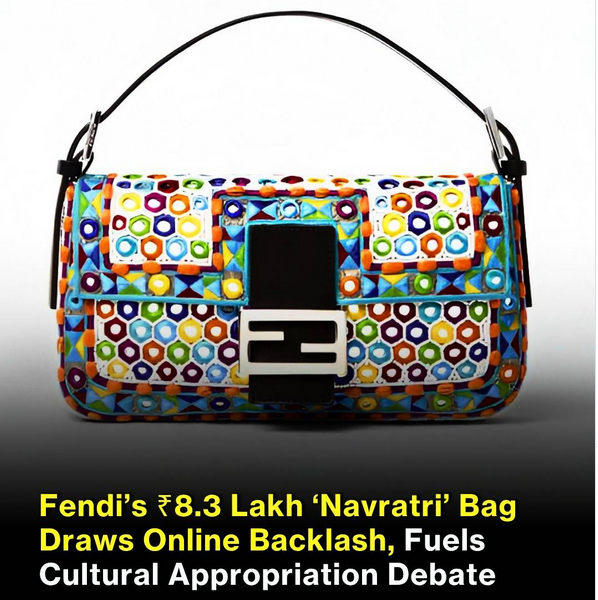
That criticism is more complicated than the first posts suggested. Fendi’s current product page describes the bag as a Fall/Winter 2026–27 re-edition, priced at $10,000, with 39,500 beads, 475 mirrors and more than 138 hours of handwork. Crucially, it says the piece is “Made in Italy and India by Chanakya artisans”. Hindustan Times reported that the embroidery is handcrafted in India while the leatherwork, lining and final assembly occur in Italy.
The public dispute began after creator @nirjalicious posted about Fendi “preparing us for Navratri” on September 2. Goenka then compared the bag with ₹500 Gujarat-market designs, while Mazumdar-Shaw called the situation cultural appropriation. Those are attributed reactions, not proof that Fendi copied a specific Indian product. The independently verifiable point is narrower: the design’s visual language triggered an Indian credit conversation, even though Fendi had already promoted Chanakya’s involvement in an April 19 video.
That distinction matters because Indian luxury embroidery is not an invisible finishing service. Vogue reports that Mumbai-based Chanakya International has produced embroidery for Fendi and other global houses, while also building its own label, Chorus. The question, therefore, is not whether Indian artisans touched this bag; current evidence says they did. It is whether a product page, campaign video and Italian luxury framing make their contribution prominent enough for the craft and the people behind it.
Read more about Fendi's Rs 9 Lakh 'Navratri Bag' Sparks Debate, Here's The Truth Behind It
The “Navratri bag” label captures why Indian readers recognised the resemblance, but it does not establish cultural ownership or copying. The more useful criticism is about visibility: if Indian handwork helps create a $10,000 object, its makers and craft context should be as easy to find as the brand name. Fendi has supplied credit; the debate is whether it supplied enough.