So this Nashik case… it’s a bit messy, not in a dramatic way, but in that uncomfortable, unclear way. A woman employee linked to Tata Consultancy Services became part of an investigation involving alleged sexual harassment, and somehow it also got tangled with claims around religious conversion. But here’s the part that really sticks, the internal committee reportedly found no formal complaint filed under the POSH system. And now, the woman is said to be untraceable or “absconding.” So you’re left thinking… wait, if nothing was formally filed, then what exactly are we even evaluating here?
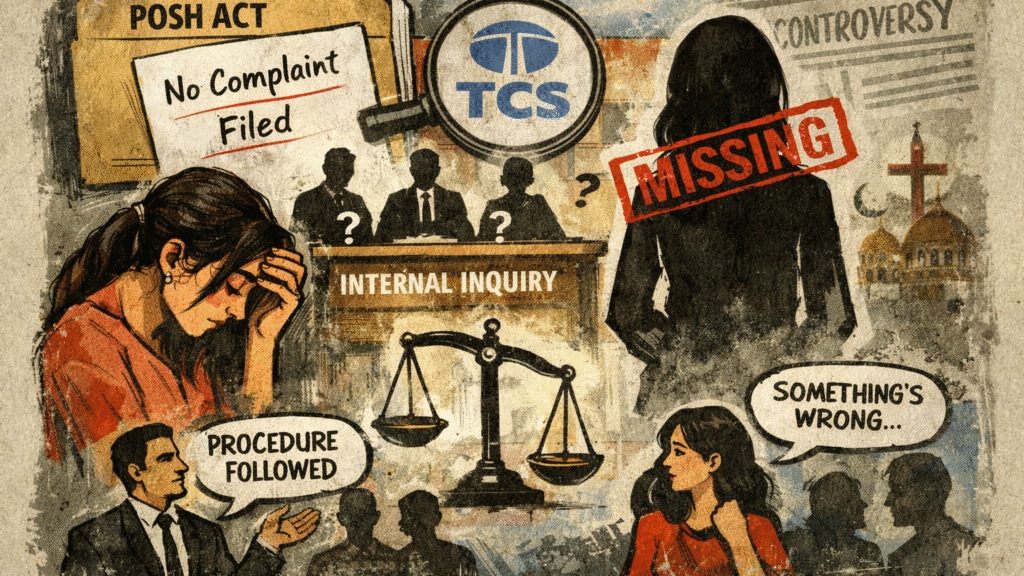
From what’s been reported through outlets like The Times of India, the company initiated a fact-finding process, and a four-member panel looked into it. Their conclusion? No official complaint exists within the framework of the Sexual Harassment of Women at Workplace (Prevention, Prohibition and Redressal) Act, 2013 – the POSH Act. Which, technically, puts the organisation in a “procedurally correct” position. But… that’s also where it starts feeling incomplete. Because in real life, people don’t always follow procedure, right? Especially in something as sensitive as workplace harassment.
The thing is, and this is where it gets interesting from a human lens – systems like POSH assume a kind of rational decision-making. Like, “if something happens, you file a complaint.” Simple. But that’s not how people behave. There’s fear, social pressure, career risk… all of that creates what economists would call a default bias. The easier path is silence. Not filing becomes the default option. And once that becomes the norm, the system unintentionally nudges women away from reporting. Not because the law is weak… but because the cost of using it feels higher than staying quiet. That’s the real friction point.
And then companies, understandably, maybe – rely heavily on “no complaint was filed” as a defence. Which again, makes sense on paper. But in practice, it kind of shifts the burden back onto the individual. Like, the system says “we’re here for you,” but only if you step forward in a very specific way. So now you’ve got this gap… between policy design and actual human behaviour. Some people are saying the company followed due process, others feel something deeper is being missed. And both can be true at the same time, which is what makes it so… unresolved.
And honestly, this isn’t just about one case. It’s more like a pattern that keeps repeating quietly. Laws exist, policies get updated, gender equality in India is talked about more than ever… but the lived experience doesn’t always move at the same speed. So you start wondering – is the issue really about lack of protection… or is it about how those protections are structured, and whether they align with how people actually behave? Because if the system waits for a complaint… and the complaint never comes… then what really happened there?
If this conversation got you thinking about how India’s laws shape who gets to exist on their own terms, there’s another story worth reading.
Read more: 298 Votes Won and Women Still Lost →